"Caves of Qud": A review
I don't know when I first became aware of Caves of Qud.
It seems like it always been out there, a strange crystalline artifact of a game, which I had never actually played. Still, I had heard rumors – elaborately simulated gunfights against robots, strange powers and extra limbs, a bizarre far-future post-apocalyptic landscape...
The official 1.0 release was on December 5th, 2024, after nearly 15 years of development. At this point, I decided it was finally time to pick it up. I played for dozens of hours, making it a significant way through the main storyline – though not all the way to the end. Here are a few places I played Caves of Qud:
- In my home office after work
- Sitting on the couch with my wife
- In a small curtain-separated alcove at the local emergency department
- In the surgical department's waiting room, slightly past midnight
I haven't picked it up since, but I'd like to tell you about my experience.
Caves of Qud is a roguelike set in the far future, where subsistance farmers and junk traders live in the shadow of a mysterious "spindle" megastructure.
It inherits many of the genre's tropes: procedural generation, random encounters, and a cryptic, keyboard-heavy user interface.
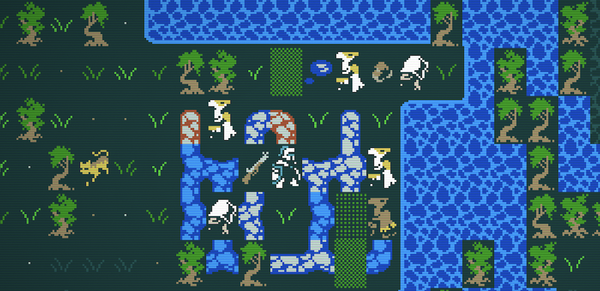
There's a main plotline, but the backstory and world-building is obscure: it's scattered across books, dialog, artifacts. Much is left implied; you have to read between the lines. The game's writing – like the user interface – is challenging to get into, but rewards the effort put into piecing it together.
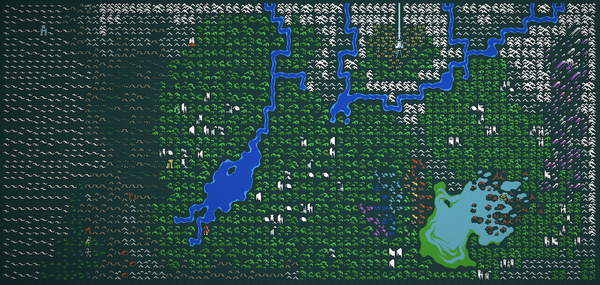
Like most roguelikes, Caves of Qud is different every time. The world map has a constant structure built around certain fixed points, but individual zones – and the eponymous caves below the surface – are all procedurally generated.
Interactions are also randomized. When you swing a vibro blade or fire a laser rifle, the game evaluates an elaborate formula to figure out if you hit, how many times, and what kind of damage is done.
There's always an element of chance to these things.
Sometimes, you get unlucky.
The world of Qud is salty and arid, due to a historical disaster hinted at in books and artifacts. Fresh water is scarse, and serves as a universal currency for trading; pools of clean water will turn brackish over the course of minutes.
Despite its inhospitable climate, Qud isn't completely barren: there are pockets of civilization ranging from small farms to villages.

Sentience is everywhere: you can talk with nearly every creature, or deploy a can of Spray-A-Brain to uplift inanimate objects. Most villagers are friendly and willing to trade gossip and wares:
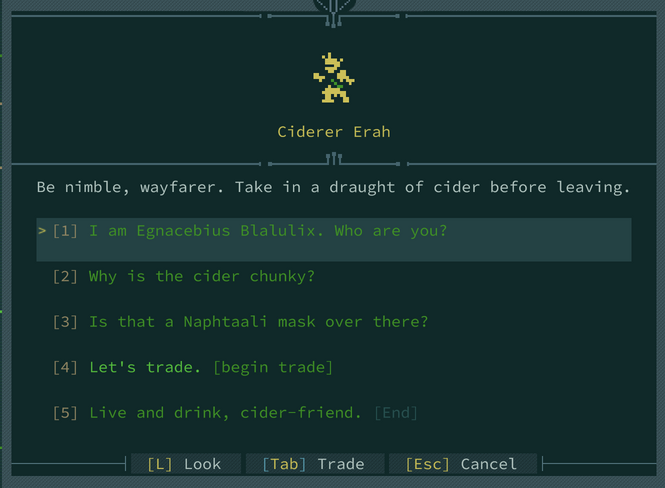
Most villagers are friendly, but there are always exceptions. In one memorable case, I walked into a town and was immediately attacked by the merchant, a sentient cucumber plant named "Yurl" – because he disliked the fungal infection growing on my arm.
Every kind of creature has different idioms and styles of speaking, but the value of fresh water is universal: "live and drink" is a common greeting.
More than anything, Caves of Qud feels like a story generator.
Let me give you another example.
Baboons are a common low-level enemy. When you get close to them, they will throw rocks at you. You can befriend them gradually, by sharing gossip and striking down their enemies – or you can stab them with a Love Injector, which immediately causes them to fall in love with you.
While being hassled by a troop of baboons, I forcibly "befriended" the leader of the group, then invited him to join me on my adventures. What I didn't realize is that he would bring his entire gang with him.
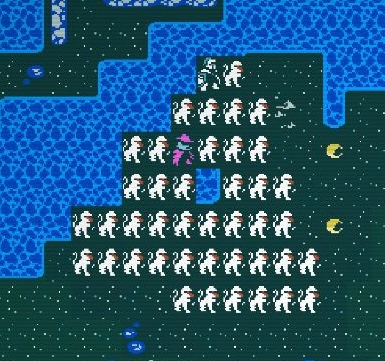
I had become the accidental leader of a Baboon Army, and the game's framerate slowed to a crawl as they en masse hurled rocks at my enemies.
Did you know that power outlets in the ER are color-coded? The red outlets are connected to uninterruptible power, i.e. backed by generators; they're meant to be used for life-critical equipment. It turns out that you're not supposed to charge a laptop from a red outlet, even if the Baboon Army is draining its battery at a prodigious rate.
Characters in Qud have incredible morphological flexibility. I played as a "True Kin" character, which meant that I couldn't acquire beneficial mutations, but allowed me to use cybernetic implants. By the late-game, I was wielding four guns (one in each hand, plus two installed on my equipment rack); I was also equipped with a sword, shield, and legendary jetpack.
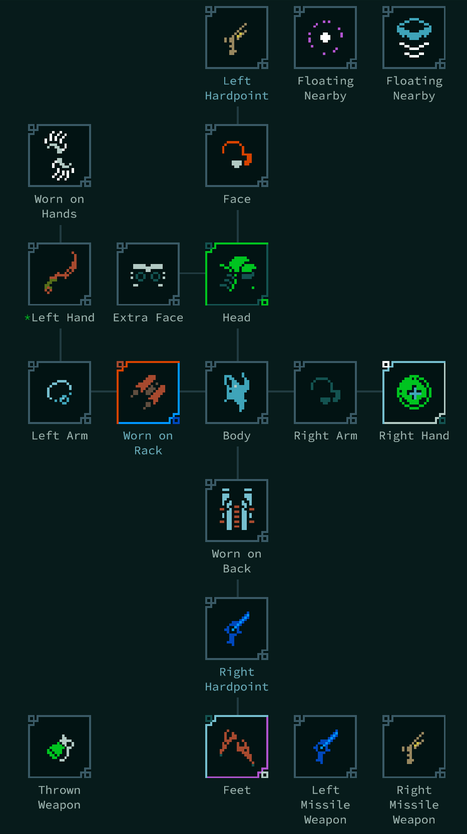
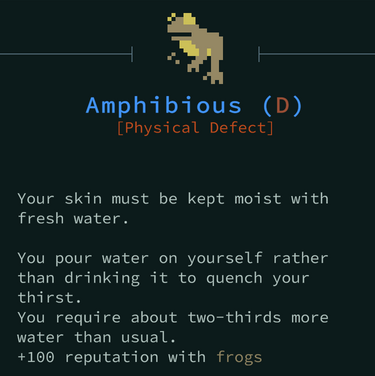
My character had also somehow become amphibious.
It can get much weirder, though: going down the mutant path, you can have multiple arms, legs, wings, and psychic powers. A character can even be budding, a temporary state in which a clone grows from a protuberance on the character's body, then pops off fully formed.
When my wife got pregnant for the second time, we kept our hopes small.
As you know, there's an element of chance to these things.
Still, sometimes you get lucky.

Caves of Qud (2024): ★★★★★
An incredible experience, with a steep learning curve